Public-Engagement Galleries in China Biotech Centers
Led a small design group developing public-facing gallery spaces inside genomics and big-data tech centers in China. Three-act flow (Create / Visualize / Use), grown out of the Biodesign Studio work at The Tech Interactive.
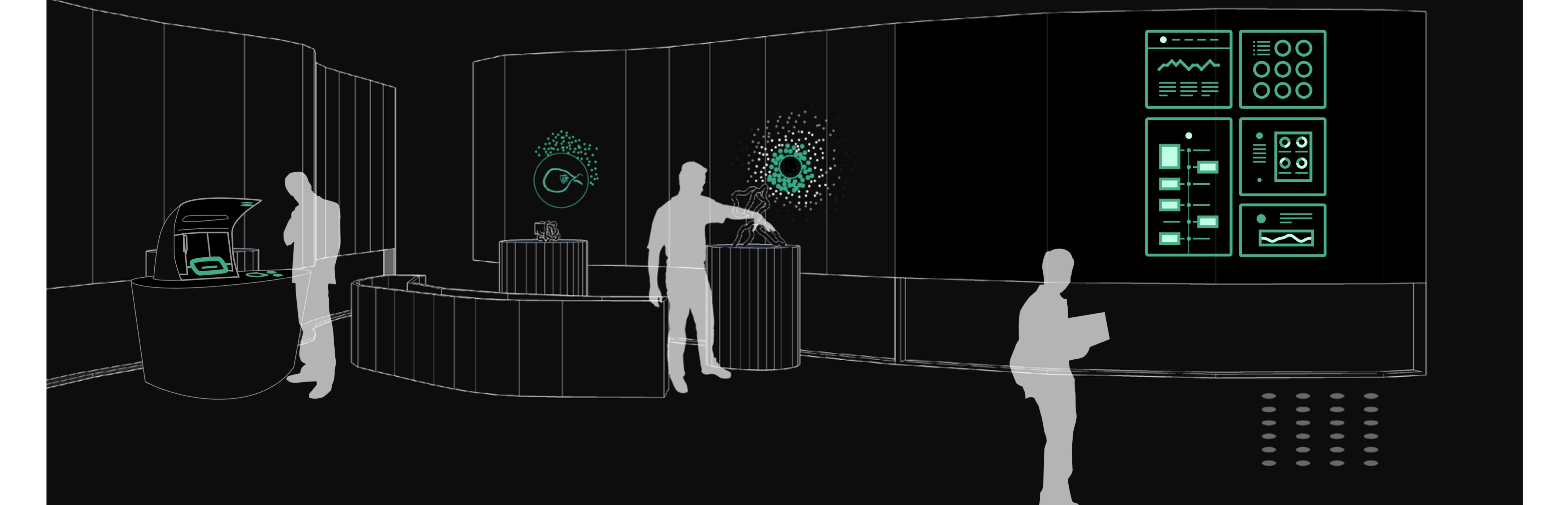
What it is. A small design group I led to develop public-facing gallery spaces inside genomics and big-data biotech centers in China. The work grew directly out of the Biodesign Studio and Body Metrics exhibitions at The Tech Interactive: same logic of letting visitors handle the science directly, repointed at the on-site populations of working biotech campuses.
The problem behind it. The brief from the centers was to help local visitors understand the work happening inside the buildings and to build public confidence in the field. A standard corporate-visitor center wasn’t enough. A standard science-museum hall didn’t fit either. The spaces needed to be specific to the science of the host campus.
The three-act gallery. The design carried a Create / Visualize / Use arc:
- Create — Genomic Testing Station. A hands-on entry point where the visitor encounters the front end of a real testing workflow.
- Visualize — Sequencing Sim + Data Analysis. A simulation surface for what happens once the sample becomes data: the steps of sequencing and the basic analytic moves.
- Use — Operations Feed. A dashboard-style wall showing how the data flows back out into operations, so the visitor can see what the building they are standing in actually does.
What I did. Led the design group: concept, three-act spatial architecture, content development for each station, and direction of the local production team. The galleries were developed as site-specific concepts for each host campus.
Why this project, for me. A direct case of moving a science-center method into a working biotech facility. The visitor isn’t being told the story of genomics in the abstract. They’re inside the building where it happens.
Collaborators
- Small design group (concept, exhibit design, content)
Related projects
- 2013–2017
BioDesign Studio
Permanent exhibition on synthetic biology, with a working biological design lab on the museum floor, tangible-tabletop microbe simulators, live cell-culture stations, and visitor-runnable design tools.
- 2013–2016
Body Metrics
Permanent exhibition on wearable biometrics, biofeedback, and mindfulness. Visitors used real-time physiologic data to explore attention, stress, and emotional state.
- 2013
Human Data Exhibition
Early Tech Interactive program on biometric data and self-quantification, supported by Kaiser Permanente.