Artist-Scientist Festival Residency
NSF-funded residency program pairing artists with scientists to produce festival-scale public-engagement work. Residency Director and event producer with Guerilla Science / Pratt Institute.
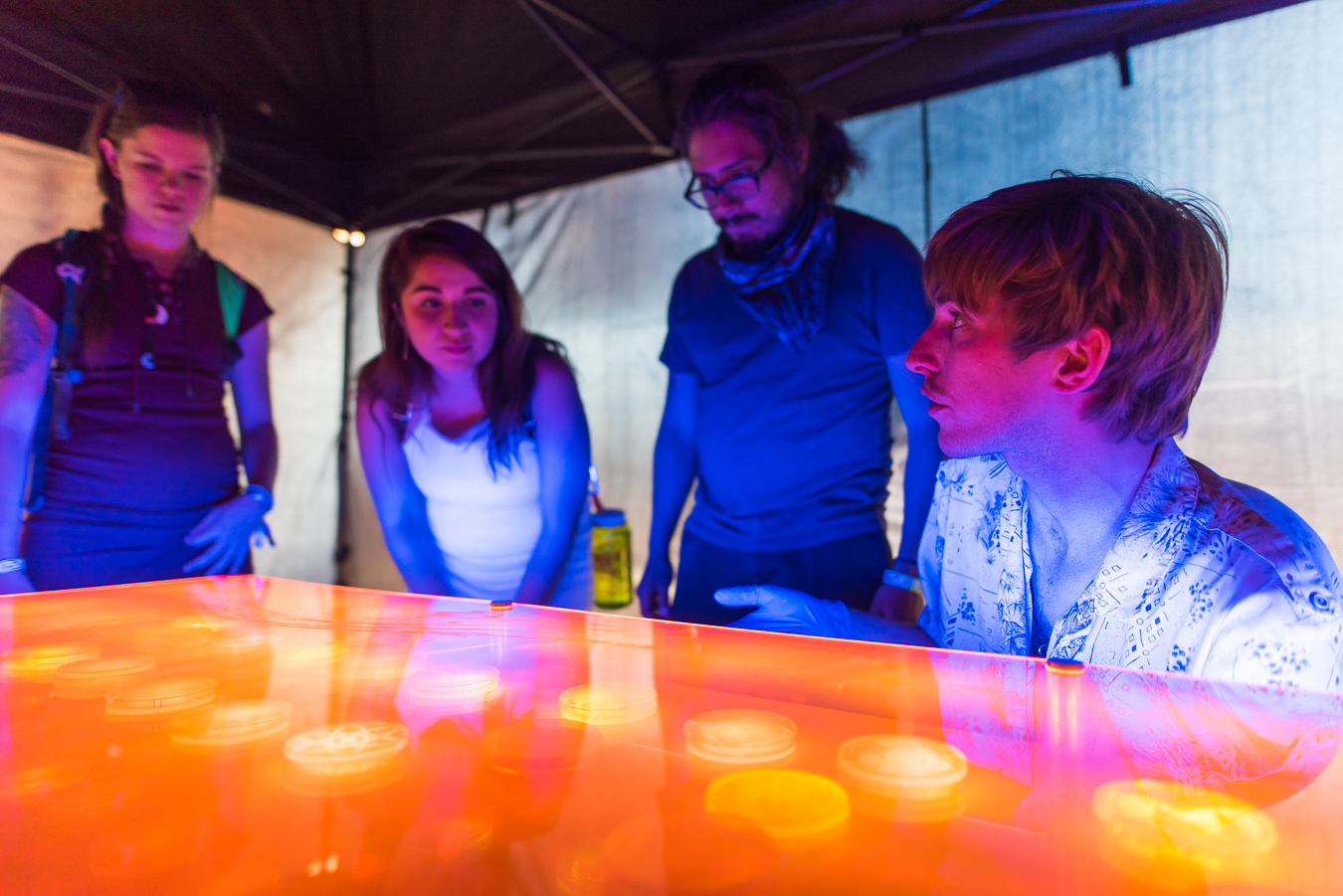
What it is. A four-year NSF-funded residency program (Award #1612719, 2016–2020) pairing artists with scientists for several months of structured collaboration, producing festival-scale public-engagement work at major US music and arts festivals. The PI institution was Pratt Institute, with Mark Rosin as Principal Investigator. The producing partner was Guerilla Science LLC.
The problem behind it. Public-engagement science by 2016 had a reach problem and a depth problem at the same time. Festival programming reaches large audiences but tends to be entertainment-shaped. Lecture-shaped programming has depth but reaches the already-converted. The residency asked whether artist-scientist pairs, given real time and structured technical support, could land at festivals with material that was both substantive and embodied. The NSF grant funded both the program and the evaluation research that came out of it.
What I did. Over the 2017–2018 cycle I was the residency director and the event producer: I directed the residency across its two Pratt years (ten pairs in the 2017 cohort, with additional pairs selected for 2018) and produced the festival programming it shipped. I mentored the artist-scientist pairs through technical, project-management, and presentation work and produced the festival-floor productions on the ground. I held a concurrent Visiting Assistant Professor appointment at Pratt’s Math and Science Department, teaching coursework that integrated biology, design, and interactive technology. Mark Rosin led academic and grant-administration as PI.
How the program was structured. Each pair received a stipend of $3,000 per artist, $500 per scientist, and $800 in materials, plus structured technical mentorship at Pratt and producing support through Guerilla Science. The open call surfaced a wide topic set: the science of yoga and meditation, the neuroscience of recreational drug use, synesthesia, the psychology of dance, diets and detoxing, climate change, identity, and music and emotion. The selection criteria looked past science demonstrations, lab coats, and geek chic, toward work that defied convention, inspired wonder, and sparked curiosity. The shared standard for what a successful pair had to produce was an experience that was both wondrous and lingering.
The events I produced. The festival and installation work produced under this Guerilla Science period has its own pages: Oregon Eclipse 2017, FIGMENT, and the Burning Man installations Flavor Feast (2017) and the Intergalactic Travel Bureau (2018).
Funding
- National Science Foundation Award #1612719 (Producer / Residency Director (PI: Mark Rosin, Pratt Institute))
Collaborators
- Pratt Institute — NSF PI institution; Mark Rosin, Principal Investigator
- Guerilla Science LLC — producing organization
Press and references
Related projects
- 2017
Guerilla Science: Oregon Eclipse 2017
Festival-scale science programming I produced for Guerilla Science at the 2017 Oregon Eclipse Festival, as part of the NSF artist-scientist residency.
- 2017–2018
Guerilla Science: FIGMENT
Participatory science-and-art festival programming I produced for Guerilla Science at FIGMENT during the 2017–2018 producer period.
- 2017
Guerilla Science: Flavor Feast (Burning Man 2017)
A Guerilla Science multisensory dining installation I produced at Burning Man in 2017.
- 2018
Guerilla Science: Intergalactic Travel Bureau (Burning Man 2018)
A Guerilla Science immersive space-travel installation I produced at Burning Man in 2018.
- 2023
Immersion to Action
Cross-disciplinary research program studying how immersive science programming changes audience behavior after they leave the room. Gebert Rüf Scientainment Grant.